Built · 11 days for the initial version; ongoing development
melee
A hosting platform for small, mostly-idle Ruby apps. Each app is compiled to a native binary, sandboxed by the kernel, and woken on demand to answer a request in well under a millisecond.
Visit the app ↗ · Private repo
Built with: Rust · Ruby · Spinel · SQLite
Two thoughts drove this idea:
- I can build my ideas for apps so quickly now that I need to think bigger
- I often build small apps on Cloudflare Workers which is a shame because I actually like Ruby but spinning up a new Rails app, kamal deployment etc is just way too much for the sort of small apps I’ve been building.
If I’m even using Ruby any more, that doesn’t bode well for the future of the language. So what does Ruby need to survive in the future?
Well, the existing Rails apps will still be there to work on, and Rails is still a good fit for starting bigger apps, but knocking out small personal/internal projects like I’ve been doing? Nah. That’s not a Rails-shaped hole. We need something much smaller, lighter-weight, which can scale only when it needs to. Cloudflare Workers is a really good product but it’s javascript-centric.
What if… I could build a new serverless platform and web framework for Ruby?
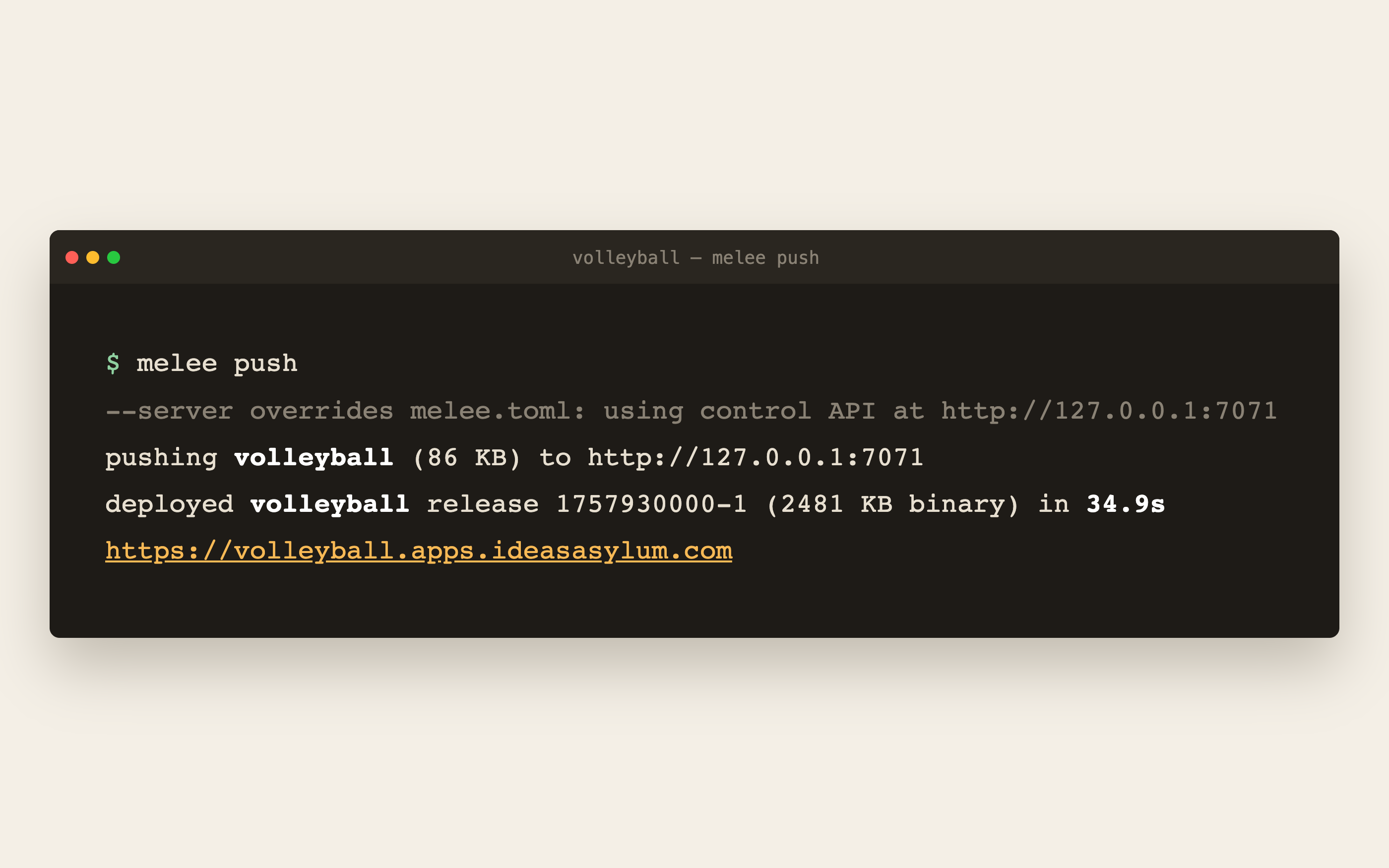
melee is that. You write a small Sinatra-shaped Ruby app, run melee push, and it comes back with a URL. On the server the app is compiled to a standalone native binary with Spinel, a Ruby-to-C compiler, wrapped in a kernel sandbox, and left asleep until someone asks for it. The first public melee app was the volleyball rotation trainer; Dinner Time, goodnews and Ferry have followed it onto the same box.
Durable objects
The primitive that makes small apps easy is the durable object: a named Ruby object with its own SQLite storage and a timer, which survives requests, restarts and deploys. This is the solution for background jobs, scheduled jobs, and even as an sort of ORM.
A game in the volleyball app is one of these. The URL contains game id, many of the routes go directly to the durable object (no custom app code), and a game is deleted after a week using the timer.
class Game < Durable
  IDLE_SECONDS = 604_800

  def setup
    storage.put("system", "5-1")
    new_match
    touch
  end

  def point(winner)
    m = match
    return nil if over?(m)
    if winner.to_s == "them"
      m["them"] = m["them"].to_i + 1
      m["serving"] = 0
    else
      m["us"] = m["us"].to_i + 1
      if m["serving"].to_i.zero?
        m["rotation"] = (m["rotation"].to_i + 1) % 6
        m["serving"] = 1
      end
    end
    save(m)
    touch
  end

  def on_timer
    idle = Time.now.to_i - storage.get("last_used").to_i
    idle >= IDLE_SECONDS ? destroy : timer(after: IDLE_SECONDS - idle)
  end
end

get "/g/:token" do
  token = known_token
  render :game, token: token, state: Game.get(token).state
end

post "/g/:token/point" do
  token = known_token
  Game.get(token).point(params.fetch(:winner, "us"))
  redirect "/g/#{token}"
end
How it works
A Rust supervisor, melee-server, terminates HTTP and routes by hostname. Each app gets one warm process that starts once and then blocks. Every request is answered by a fork() of that process, an OS-level clone that already has everything loaded, which exits after one response. Server and app talk over UNIX socket pairs with a framed protocol, one pair per concurrency slot, so answers never interleave.
Before an app runs, the server wraps it in layers of sandbox: its own uid and gid, user and mount namespaces, a Landlock allow-list of filesystem paths, a seccomp allow-list of system calls (anything else kills the process), and cgroups for memory, CPU and process count. Durable objects live in a separate worker process per app inside the same sandbox, each with its own SQLite file. A bug in one app can’t reach the host or another app.
Development uses none of this. melee dev runs the unmodified source under CRuby with reloading, and production runs the same source compiled by Spinel into a 2 to 3 MB binary. That gap is the platform’s main risk, so every example app carries a parity test that runs the same requests through both.
The numbers, from the research docs in the repo:
- Warm request: 0.165 ms at p50, 0.40 ms at p99, sandboxed on Linux.
- Fork activation: 0.095 ms at p50. Full cold path from spawn through sandbox and first request: 1.6 to 2.6 ms.
- Resident memory per warm app: 2 to 5 MB, plus about 5.5 MB for a durable-object worker. Spinel idles at 3.8 MB against CRuby’s 25 MB.
- Compile: about 4 s for a warm build, 30 to 37 s for a first one. Binaries are 2.1 to 2.5 MB.
Deploying is melee push --to prod from the laptop. The source goes over SSH to a control API on a UNIX socket, the server compiles and activates the release, and Caddy in front handles TLS. A read-only dashboard and health checks through each app’s public URL came later. The production box is a single small Debian VM dedicated to melee; the install, including building the compiler and the server, took under six minutes, and the first push 35 seconds.
The same app on Cloudflare Workers
To check I wasn’t kidding myself, I rebuilt the volleyball app on Cloudflare Workers with Durable Objects. The two durable-object models map almost call for call and the port took an afternoon. The TypeScript version was about a quarter more code for the same geometry, with 78 lines of platform config across five files and 90 npm packages, against melee’s ten lines, two files and no dependencies. The difference that actually mattered was the dev loop: wrangler dev runs the production runtime, while melee’s dev runs CRuby and production runs a Spinel binary, which is exactly why the parity tests exist.
What’s not there yet
Today’s deployment is single-tenant on purpose. Most of the multi-tenant hardening is now built (a uid per app, a Landlock allow-list, a sandboxed build with its own seccomp denylist and cgroup, and firewall rules that keep apps away from the box’s own services) but I don’t yet trust it with other people’s apps. The melee CLI is now a single binary with the standard library embedded, which builds the pinned Spinel on first use, though there are no prebuilt binaries or install script yet. Each release records what built it, but nothing is signed. melee new writes an AGENTS.md into every app; the rest of the agent-facing surface (an MCP server, scoped tokens, branch previews) and the multi-machine work (SQLite replication, placement, custom domains) are planned but not started. The repo is private for now, but the manual is public at melee.ideasasylum.com.